
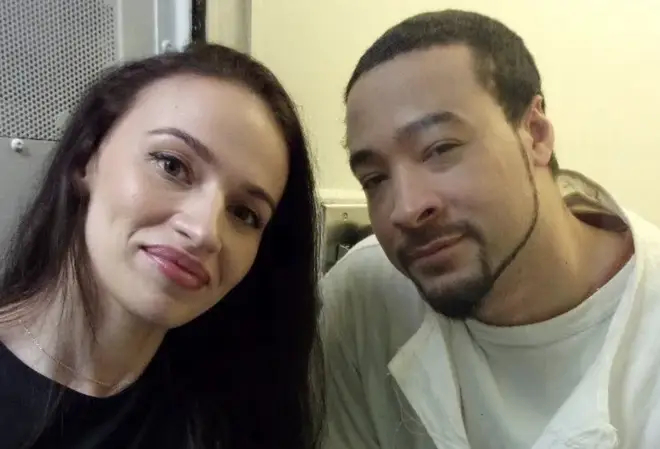
Tiana Broadnax’s husband, James Broadnax, was executed in Texas on April 30, 2026. She watched him die through a glass window, screaming “I love you” as he was strapped to a gurney and injected with lethal drugs. Two weeks earlier, they had married in a prison ceremony where they weren’t allowed to touch, kiss, or hold hands. For Tiana, a British law school graduate and mother-of-one, this wasn’t a random act of rebellion. It was the culmination of an 18-month relationship that began as academic research and ended in a tragedy that has captivated the world.
Who Was James Broadnax?
James Broadnax was a 37-year-old death row inmate in Texas. He was convicted of the 2008 shooting deaths of Stephen Swan, 26, and Matthew Butler, 28, two Christian music producers killed in a recording studio car park in Garland, Texas.
Broadnax maintained his innocence until his final breath. His case drew national attention not just because of his marriage to a British woman, but because of serious questions about his conviction. His cousin, Demarius Cummings, had confessed to being the actual shooter in a sworn affidavit filed just weeks before the execution. Cummings claimed he pulled the trigger, and his DNA, not Broadnax’s, was reportedly found on the murder weapon.
The confession was dismissed by Texas officials as “questionable new evidence.” The execution proceeded anyway.
How Tiana and James Met
Tiana Krasniqi, 31, was studying for a Master’s degree in International Human Rights Law at the University of Law when she first contacted Broadnax in October 2024. Her dissertation examined racial disparities in the US capital punishment system. Broadnax, a Black man convicted by a jury that allegedly excluded African American jurors until the very last minute, seemed like a perfect case study.
She found him through a prison pen pal website. Her first message made her intentions clear: she was not looking for a relationship. He agreed, saying he had no energy for a girlfriend and needed to focus on saving his life.
That plan didn’t last.
Emails turned into phone calls. Phone calls stretched into six or seven hours a day. They talked about their childhoods, their faith, their dreams. Tiana, born in Kosovo and raised in London’s foster care system after her sister’s death, found a kindred spirit in a man who had experienced abuse and trauma of his own.
Within months, they were in love.
The Proposal Behind Glass
James proposed during a visitation. There were no fireworks, no flowers, no romantic restaurant. There was only a glass screen and a prison phone.
Tiana said yes.
She flew to Texas for the first time in early 2025 to meet him face-to-face. They spent 90 days together, always separated by reinforced glass, sharing meals they called “date nights.” She dressed up. He hand-washed his clothes the night before every visit.
They were married on April 14, 2026, at the Allan B. Polunsky Unit in Livingston, Texas. The ceremony lasted 20 minutes. Two prison guards served as witnesses. The bride wore white. The groom wore prison whites. They exchanged vows through an internal telephone, separated by bulletproof glass.
Tiana said it was “not the most romantic” wedding. But it was real to them.
The Final Days
As the execution date approached, Tiana launched a desperate campaign to save her husband’s life. She gathered 88,000 signatures on a petition. She enlisted the help of high-profile rappers, including Travis Scott, T.I., and Killer Mike, who filed briefs with the Supreme Court in support of Broadnax’s appeal.
She moved to Houston, leaving her nine-year-old daughter in the UK with her father, to fight full-time for James’s freedom. She traced his life across multiple states, interviewing shopkeepers, neighbors, and school friends. She believed in his innocence with absolute certainty.
On April 30, 2026, all appeals were denied.
Watching Her Husband Die
Tiana was in the execution chamber viewing room when James was put to death. She pressed herself against the window, arms outstretched, screaming “I love you” as the lethal injection was administered.
The execution took 21 agonizing minutes. James used his final words to proclaim his innocence one last time: “Texas got it wrong. I’m innocent, the facts of my case should speak for itself.”
After he was pronounced dead, Tiana was helped out of the prison, inconsolable.
But the most devastating moment came afterward. Forty minutes after his death, Tiana was allowed into a chapel where James’s body had been taken. For the first time in their entire relationship, she was able to touch him. She kissed him. She hugged him. His body was still warm.
“I forgot that I’m allowed to touch him because in my mind I thought there was still glass between us,” she said.
She noticed bruising on his neck and a nosebleed, evidence she believes shows he suffered during the execution.
Life After James
Tiana has vowed to continue fighting for James’s posthumous exoneration. She believes the evidence that could have saved him is still there, waiting to be properly examined. She has said the fight “didn’t end” with his death; it only got worse.
She has also spoken candidly about the toll the relationship took on her life. She lost time with her daughter. She faced criticism from friends and family who couldn’t understand why she would marry a death row inmate. She acknowledged that her loved ones offered “no support,” though she said she doesn’t hold grudges.
She has the name “James” tattooed on her left wrist.
In a TikTok post after the execution, she wrote: “They killed my husband. You killed Mr Broadnax, but you ain’t killed MRS BROADNAX.”
A Love Story That Defies Easy Judgment
Tiana Broadnax’s story is not simple. It raises uncomfortable questions about the death penalty, racial injustice, and the human capacity for connection in the most unlikely circumstances. Was James Broadnax guilty? The courts said yes. His cousin said no. The DNA evidence remains disputed.
What isn’t disputed is that Tiana loved him. She loved a man she could never hold until it was too late. She married him knowing she would likely watch him die. And she is still fighting for him, long after the state of Texas decided his fate.
Whatever you believe about James Broadnax’s guilt or innocence, Tiana’s story is one of devotion in its rawest, most painful form. It’s a reminder that love doesn’t always follow the rules. Sometimes it shows up behind glass, in a prison chapel, or in the final moments of a life that someone else decided to end.
Leave a Reply