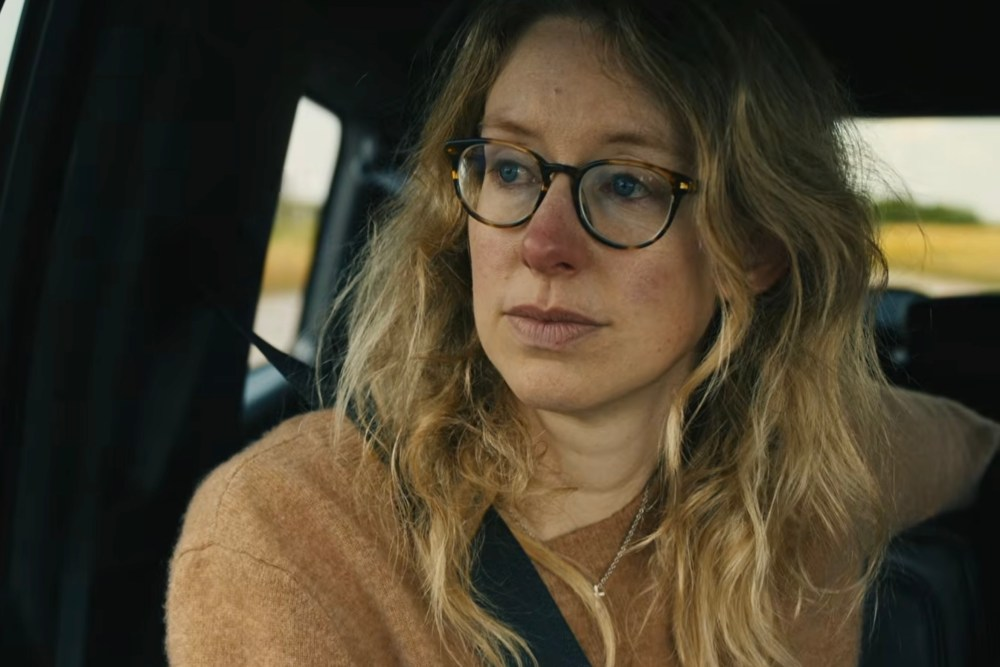
A new Elizabeth Holmes documentary is taking an unusually intimate approach to one of Silicon Valley’s most infamous scandals. You Can See Everything, directed by Nathan Fielder and Lance Oppenheim, follows the former Theranos founder during the final weeks before she entered federal prison, with cameras gaining remarkable access to her home, partner and family life.
The nearly three-hour film runs 174 minutes and is scheduled to open in theaters on October 16, 2026. Rather than simply retelling the familiar rise and collapse of Theranos, the documentary places Holmes directly in front of a skeptical film crew and asks a more uncomfortable question: what happens when someone who has spent years being scrutinized is given another opportunity to tell her own story?
What Is the New Elizabeth Holmes Documentary?
You Can See Everything is a feature-length documentary centered on Elizabeth Holmes in the period immediately before and after she began serving her federal prison sentence.
The film starts 34 days before Holmes was due to report to prison. She allows Fielder, Oppenheim and a small crew extraordinary access to her daily life, giving the filmmakers an opportunity to observe moments that previous documentaries and dramatizations could not capture.
What initially resembles an intimate portrait gradually becomes something much stranger. The directors begin questioning not only Holmes’ version of events but also whether the presence of cameras makes genuine transparency possible at all.
That tension appears to be one of the film’s defining ideas. Holmes wants to be seen and understood, while Fielder repeatedly questions whether what he is seeing is authentic.
When Will You Can See Everything Be Released?
You Can See Everything will receive a theatrical release on October 16, 2026.
A24 is distributing the documentary and has listed it among its upcoming theatrical films. The movie runs for 174 minutes, making it considerably longer than a typical documentary feature.
The extended runtime reflects the unusual scope of the project. What began as filming Holmes during her final month of freedom eventually developed into a production spanning roughly three years.
That longer timeline means the documentary is not limited to the days immediately before Holmes entered prison. Instead, those early encounters become the starting point for a much larger examination of Holmes, the filmmakers and the difficult question of who controls a documentary narrative.
Nathan Fielder Moves Into Elizabeth Holmes’ Home
One of the most striking aspects of the Elizabeth Holmes documentary is the level of access granted to Nathan Fielder.
During filming, Fielder effectively moves into the San Diego-area home Holmes shared with her partner, Billy Evans, and their two young children.
The arrangement gives the production near-constant access to the family’s routines. In the trailer, Fielder directly asks Holmes whether she is comfortable allowing a film crew into such a private environment.
His presence quickly becomes part of the story rather than simply a filmmaking device.
Instead of standing behind the camera as a detached interviewer, Fielder increasingly interacts with Holmes and Evans, questioning their explanations and pushing into areas that create visibly uncomfortable exchanges.
Elizabeth Holmes and Billy Evans Face Difficult Questions
Billy Evans, Holmes’ longtime partner and the father of her children, is also an important figure in You Can See Everything.
Fielder questions Evans about his relationship with Holmes and whether he ever worried about being misled by someone whose criminal case centered on deception of investors.
The exchanges shown publicly suggest the documentary will not simply allow Holmes and Evans to present their preferred version of events without challenge.
Holmes repeatedly maintains that she is being genuine with the filmmakers. Fielder, however, appears reluctant to accept transparency at face value.
That push and pull gives the movie an unusual tone. It is part character study, part interrogation and part examination of how documentaries create their own version of reality.
Why Was Elizabeth Holmes Sent to Prison?
Holmes founded Theranos and became one of the most celebrated figures in Silicon Valley after claiming the company could perform a wide range of medical tests using very small amounts of blood.
The company’s promises eventually came under intense scrutiny, leading to investigations, criminal charges and the collapse of Theranos.
A federal jury convicted Holmes in January 2022 of one count of conspiracy to commit fraud against investors and three counts of wire fraud involving individual investors. She was acquitted of several patient-related counts, while jurors were unable to reach verdicts on several additional investor counts.
In November 2022, Holmes was sentenced to 135 months in federal prison, equivalent to 11 years and three months. She ultimately reported to Federal Prison Camp Bryan in Texas on May 30, 2023.
The documentary begins just over a month before that surrender date.
How Is This Documentary Different From Earlier Holmes Projects?
The Theranos story has already inspired documentaries, books, podcasts and scripted television.
The 2019 documentary The Inventor: Out for Blood in Silicon Valley examined the rise and collapse of Theranos, while the television drama The Dropout later recreated Holmes’ story with Amanda Seyfried playing the former entrepreneur.
You Can See Everything takes a different route.
Rather than reconstructing the years when Theranos was operating, the new film captures Holmes herself at a radically different stage of her life. Theranos had already collapsed, the criminal trial was over and prison was approaching.
Most importantly, Holmes actively participates.
That direct access changes the central question from what happened at Theranos to how Holmes now understands, explains and presents what happened.
Telluride Secret Screening Sparked Immediate Attention
You Can See Everything was kept largely out of public view during production.
That secrecy continued until the documentary appeared as a surprise screening at the Telluride Film Festival in September 2026. The screening revealed both the existence and scope of the project to a much wider audience.
Nathan Fielder and Lance Oppenheim introduced the film, which immediately generated discussion because of its unusual structure and extraordinary access to Holmes.
A teaser released around the same period showed tense conversations between Fielder and Holmes, but the later full trailer provided a clearer look at just how deeply the filmmakers entered her private life.
Why Nathan Fielder Changes the Tone of the Film
Nathan Fielder is best known for projects that deliberately make the boundary between reality, performance and manipulation difficult to identify.
That background makes him an unusual filmmaker for an Elizabeth Holmes documentary.
His conversations with Holmes appear intentionally awkward at times. Rather than delivering conventional interview questions and moving on, Fielder stays with uncomfortable moments and questions whether his subject is behaving differently because cameras are present.
Lance Oppenheim brings a different background in documentary filmmaking, making the partnership particularly interesting.
Together, the filmmakers appear less interested in producing a straightforward Theranos timeline than in exploring what happens when a documentary subject, especially one with Holmes’ history, attempts to control how she is perceived.
What Viewers Can Expect From You Can See Everything
Anyone expecting a traditional true-crime retelling may find You Can See Everything considerably different.
The documentary appears to use Holmes’ criminal history as a starting point rather than its only subject. It explores her relationship with Billy Evans, her final days with her children before prison, her continuing insistence that parts of her story have been misunderstood and her interactions with filmmakers who remain openly skeptical.
There is also an element of self-examination. Fielder’s presence becomes increasingly visible, raising questions about whether filmmakers can truly observe people without changing the situation they are documenting.
That may ultimately be what separates this Elizabeth Holmes documentary from everything that has come before it.
Instead of simply asking viewers to reconsider the Theranos scandal, You Can See Everything appears interested in a more unsettling problem: even with cameras running almost constantly, how can anyone be certain they are seeing the complete truth?