
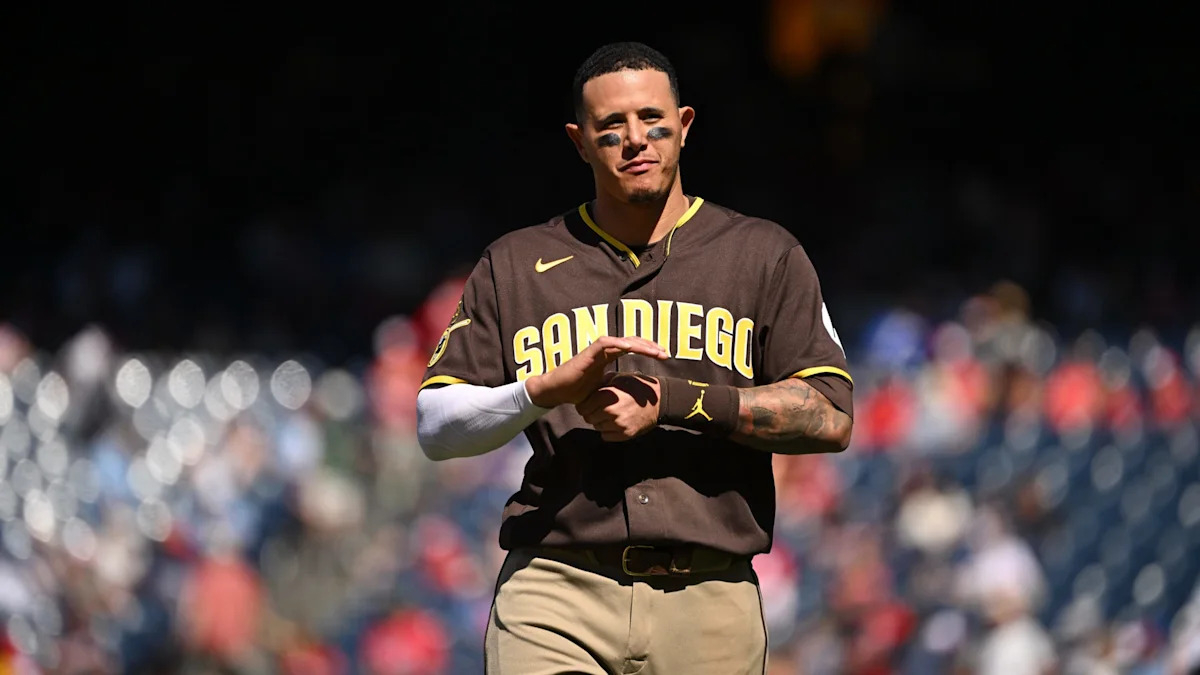
Manny Machado was supposed to be the villain. The bat-flipping, mound-charging, “not that type of player” phenom who couldn’t keep his cool when it mattered most. Twelve years, seven All-Star selections, and one $350 million contract later, he’s become something else entirely: the unquestioned heart of a franchise, a father, a philanthropist, and the player the San Diego Padres refuse to trade even as the walls close in.
Machado is 34 years old. He’s still hitting 30 home runs. He’s still the guy opposing pitchers fear in the middle of the order. And he’s still on the books for nearly $39.1 million per season through 2033, when he’ll be 41 years old. The Manny Machado story is one of the most complicated and compelling in modern baseball. Here’s the full bio.
Born to Play in Miami, Built in Baltimore
Manuel Arturo Machado was born on July 6, 1992, in Miami, Florida. The son of a Dominican-born father and a Cuban mother, Machado grew up in the same city that produced Alex Rodriguez, another Miami-area shortstop phenom who became a mentor of sorts.
The Baltimore Orioles selected him third overall in the 2010 MLB Draft out of Brito Miami Private School. He was 17 years old. By 2012, he was the top prospect in baseball. By August 2012, he was in the majors.
Machado’s rookie season in 2013 was a revelation. He hit .283 with 51 doubles — the most by any rookie in American League history and a single-season franchise record — and won his first Gold Glove at third base. He also won the Platinum Glove, awarded to the best defensive player in each league, regardless of position. He was 20 years old.
Over the next five seasons in Baltimore, Machado established himself as one of the game’s premier young stars. He made four All-Star teams, won two Gold Gloves, and finished fourth in MVP voting in 2015. But the Orioles never won a playoff series with him, and the relationship soured as the team’s competitive window closed.
The Dodgers Stopover and the $350 Million Bet
In July 2018, with Machado set to hit free agency, Baltimore traded him to the Los Angeles Dodgers. The move was designed to give Machado a chance to prove he could perform on the biggest stage — and to give the Dodgers the push they needed to end a 30-year World Series drought.
It didn’t work out that way. Machado struggled in the postseason, hitting .227 with three home runs in 13 games. He was criticized for a dirty slide into Milwaukee Brewers shortstop Orlando Arcia, for a nonchalant jog to first base, and for his general demeanor. The Dodgers lost the World Series to the Boston Red Sox.
That winter, Machado became a free agent. The market was colder than expected. He eventually signed with the San Diego Padres — a team that hadn’t made the playoffs since 2006 — on a 10-year, $300 million contract. Two years later, he opted out and signed an 11-year, $350 million extension through 2033. It was the largest contract in Padres history and one of the richest in baseball.
The San Diego Legacy
Machado’s arrival in San Diego marked the beginning of the Padres’ modern era. He was the first true superstar to choose the franchise. Fernando Tatis Jr. followed. Xander Bogaerts followed. Yu Darvish followed. The Padres made the playoffs in five of his eight seasons, including a run to the 2022 National League Championship Series.
His numbers in San Diego speak for themselves: a .258 average, 30-plus home runs in multiple seasons, and 2020 and 2022 Padres MVP awards. He made five All-Star teams with the Padres, won a Silver Slugger in 2024 and 2025, and reached the 30-homer mark again in 2026 for the first time since 2023.
But 2026 has been a strange season. Machado is hitting a career-low .216 with a .710 OPS, though he’s still produced 30 home runs and 90 RBIs. His strikeout rate is a career-high. His bWAR sits at just 1.5. The power is there, but the consistency that defined his prime has slipped.
The Contract Nobody Wants to Trade — Except Everyone
Machado’s contract is one of the most immovable in baseball. Starting in 2027, his base salary jumps to nearly $39.1 million annually through 2033. He has a full no-trade clause. And the Padres, under new ownership, are reportedly looking to shed payroll.
Trade rumors have swirled all season. Machado has had “unhappy moments” in San Diego, according to reports, and might consider waiving his no-trade clause for a winning situation. But moving him would require the Padres to pay down a significant portion of his remaining salary, and it would be a public relations disaster for a franchise that built its modern identity around him.
For now, Machado stays. He’s too important to the clubhouse, too beloved by the fanbase, and too expensive to move.
The Man Off the Field
Machado married Yainee Alonso — sister of former MLB first baseman Yonder Alonso — in December 2014 at the Château de Challain in France. The couple welcomed their first child, a son, in April 2024. Machado missed a game against the Colorado Rockies on the paternity list to be present for the birth.
Those who know him describe Yainee as his “voice of reality.” Former Yankees manager Joe Girardi once said that Machado’s wife was always the one who kept him grounded. Machado himself has described their lifestyle as deliberately quiet. “People think, ‘Oh, you’re a big-leaguer, you live in Miami, you can probably go to any club you want,’” he said. “The truth is that we are boring. We don’t really let people in. We’ve got a very close circle, and that’s it. For us, it’s all about family.”
Machado’s charitable work has grown substantially. He was nominated for the Roberto Clemente Award in 2024 for his community service, including work with the Peter Seidler Legacy Projects to help San Diego’s homeless population. His foundation, Team Machado — The Sky’s the Limit, supports youth in Miami and the Dominican Republic.
The Verdict
Manny Machado has already lived three baseball lives: the phenom in Baltimore, the mercenary in Los Angeles, and the foundational star in San Diego. He’s a seven-time All-Star, a two-time Gold Glove winner, a Platinum Glove winner, and a two-time Silver Slugger. He’s hit nearly 400 career home runs. He’s signed the kind of contract that changes a family’s trajectory for generations.
He’s also a polarizing figure who has never fully escaped the perception that he doesn’t always hustle, doesn’t always handle adversity gracefully, and doesn’t always say the right thing. The 2026 season has been his worst statistically. The trade rumors won’t stop.
But watch him in the Padres’ clubhouse. Watch him with his son. Watch him in the community. The villain era is over. What’s left is a 34-year-old man trying to win a World Series in the only city that ever fully embraced him.
Leave a Reply