
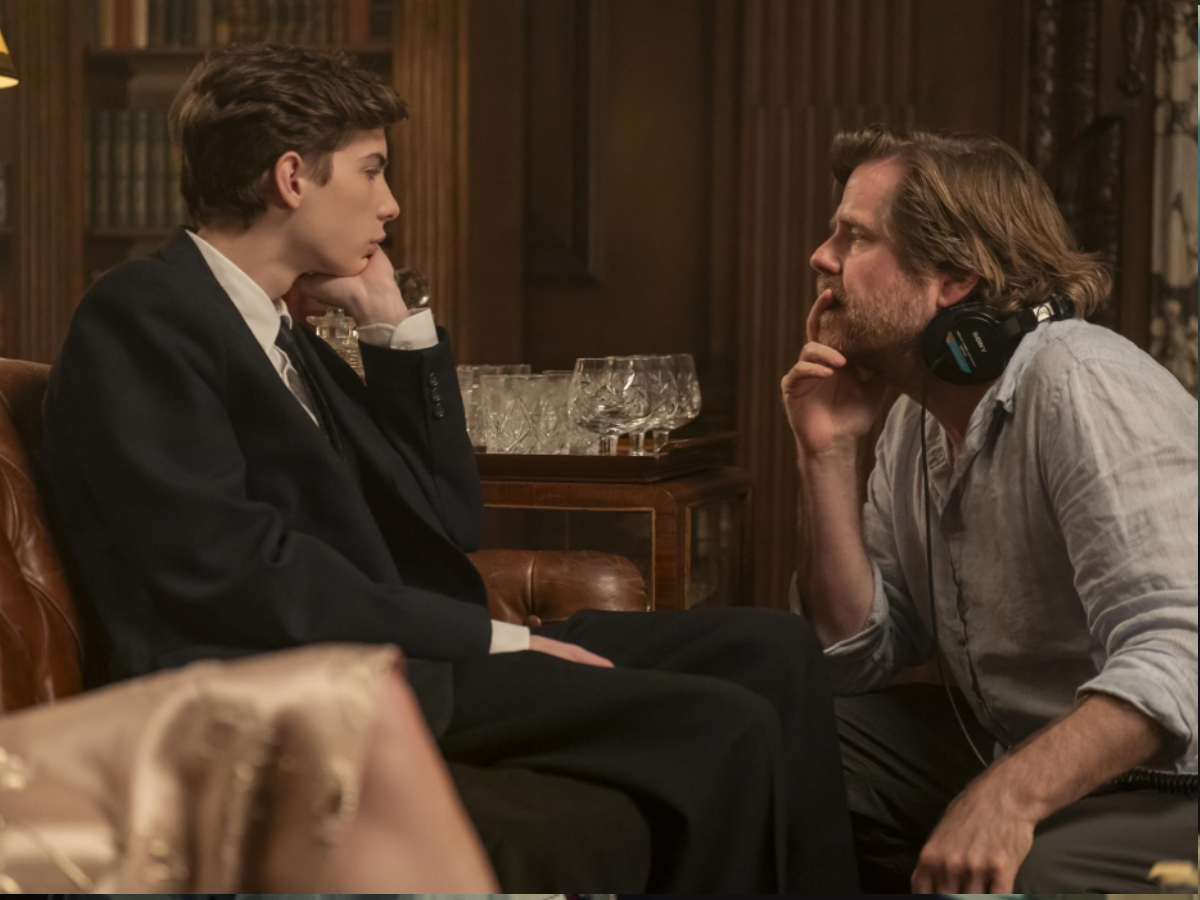
Ted Kaczynski didn’t become the Unabomber overnight. Netflix’s new film argues he was made — in a Harvard basement, by a professor who broke him on purpose. Released on September 25, 2026, Unabomber stars Jacob Tremblay as the young math prodigy and Russell Crowe as the psychologist whose controversial experiments may have lit the fuse. It’s a story about two American rooms: one in Cambridge, where a sixteen-year-old is systematically dismantled, and one in the Montana woods, where federal agents finally close in three decades later. Here’s everything you need to know about the film, the real history behind it, and why it’s sparking heated debate.
What Is Netflix’s Unabomber About?
Unabomber is a dramatized retelling of Ted Kaczynski’s life, focusing on two timelines: his years as a 16-year-old Harvard undergraduate in the late 1950s, and the FBI’s manhunt for him in the 1990s. The film is directed by Janus Metz and written by Sam Chalsen and Nelson Greaves, both former Harvard students.
The central thread is Kaczynski’s participation in a psychological study run by Harvard professor Henry Murray. What Kaczynski believed was a debate club turned out to be a government-backed experiment measuring how people respond to extreme stress. He was wired to electrodes and subjected to what Murray himself described as “vehement, sweeping, and personally abusive” interrogations that attacked his deepest beliefs.
The film cuts between this psychological dismantling and the FBI’s eventual breakthrough: Kaczynski’s own manifesto, published in newspapers, which his brother and sister-in-law recognized as his writing.
Who Was Ted Kaczynski, the Real Unabomber?
Theodore “Ted” Kaczynski was born in Chicago in 1942. A math prodigy, he skipped two grades and entered Harvard at just 16 years old. He went on to earn a master’s and PhD in mathematics from the University of Michigan, becoming the youngest professor ever at UC Berkeley at age 25.
But in 1969, he abandoned academia. By 1971, he had built a primitive cabin with no electricity or running water near Lincoln, Montana, where he lived in near-total isolation for over two decades.
Between 1978 and 1995, Kaczynski carried out 16 bombings targeting universities, airlines, and people he associated with modern technology. His attacks killed three people — Hugh Scrutton, Thomas Mosser, and Gilbert Murray — and injured 23 others. The FBI’s case code name, UNABOM, stood for “University and Airline Bombing,” which the media turned into “Unabomber.”
He was arrested on April 3, 1996, at his Montana cabin. Inside, agents found bomb-making materials, a live bomb, a typewriter, and roughly 40,000 pages of handwritten notes. He pleaded guilty in 1998 to avoid the death penalty and was sentenced to life in prison without parole.
Kaczynski died by suicide in his prison cell on June 10, 2023, at age 81. He had been diagnosed with late-stage rectal cancer and was being held at the Federal Medical Center in Butner, North Carolina.
The Harvard Experiment That Changed Everything
The film’s most disturbing thread is the Murray experiment, which Kaczynski participated in from 1959 to 1962, spending roughly 200 hours as a test subject.
Students were asked to write essays outlining their personal philosophies. Then, in brightly lit rooms with electrodes attached to their bodies, they were confronted by interrogators who attacked their beliefs with brutal personal insults. The goal was to study stress responses and interrogation techniques for potential government use.
Some historians and researchers believe Murray’s experiments may have been connected to the CIA’s MKUltra mind-control program, which explored psychological manipulation techniques during the Cold War. Murray had previously worked with the Office of Strategic Services, the CIA’s predecessor, helping select undercover agents during World War II.
Kaczynski later called the experiment “the worst experience” of his life, though he downplayed its direct impact on his crimes. Experts remain divided. Some argue the stress aggravated pre-existing vulnerabilities. Others caution against drawing a direct causal link, calling it “coincidental” rather than deterministic.
As evolutionary psychologist Nigel Barber put it, the experiment “was just one more personal grudge that he could fit into a paranoid narrative about how the world worked in general, and for him in particular.”
The Cast: Jacob Tremblay, Russell Crowe, and Shailene Woodley
The film assembles a heavyweight cast to bring the story to life.
Jacob Tremblay (Room, Wonder) plays young Ted Kaczynski. Director Janus Metz said he was the only choice after seeing Tremblay in the 2025 film Sovereign, describing him as “absolutely spellbinding” with “the will and the capacity to look for something truthful in his performance.” Tremblay approached the role with careful nuance: “I’m not really playing the Unabomber. I’m just playing a young Ted Kaczynski. The Unabomber doesn’t exist yet, so I don’t want to make him seem like a supervillain at that point.”
Russell Crowe stars as Henry Murray, the Harvard psychology professor whose experiments form the film’s psychological core. Metz called Crowe “a formidable force as a character, as a person, as an actor” who “becomes that screen presence of a very grand personality.”
Shailene Woodley plays Joanne Miller, a fictional FBI agent who pushes the bureau to focus on the Unabomber’s manifesto and the ideas within it. Metz described her character as “our entry point into the story” — the one who starts asking who the Unabomber is and what drives him.
Annabelle Wallis portrays Christiana Morgan, Murray’s professional partner and real-life collaborator at the Harvard Psychological Clinic. Wallis said Morgan was “a woman at the top levels of academia in Ivy League universities” who did “groundbreaking work,” and the filmmakers wanted her to have “gravity in the story” rather than being just “the female assistant.”
What the Film Gets Right — and Where It Takes Liberties
Unabomber is described by Netflix as “inspired by true events,” not a documentary. That distinction matters.
What’s accurate: The Murray experiments were real. Kaczynski’s Harvard years, his isolation, his cabin in Montana, his manifesto, and his brother’s role in his capture are all based on documented history. Murray did work with the CIA, and the experiments did involve stress-inducing confrontations.
What’s dramatized: The character of FBI agent Joanne Miller is fictional, created to give the investigation a narrative anchor. Certain private moments and confrontations between Kaczynski and Murray are imagined for dramatic effect. The film also implies a stronger causal link between the experiments and Kaczynski’s radicalization than historians have established.
As the Boston Globe noted, Kaczynski’s file from the experiments is “still classified,” making it a “rich canvas” for cinematic interpretation.
Why the Film Matters Today
Unabomber arrives at a moment when conversations about radicalization, online isolation, and the psychology of violence feel more urgent than ever. Director Janus Metz said the film explores “a period of time in Ted Kaczynski’s life that hasn’t been explored” much on screen, treating it as “looking at a black box.”
Tremblay agreed that the story’s relevance extends beyond true crime fascination. “What the script does that’s really good is it leaves a lot up to interpretation,” he said. “We don’t exactly know if these experiments had as much of an effect as they could of. But it really gets the conversation going, for sure.”
For viewers, the film offers something more than a retelling of notorious crimes. It asks uncomfortable questions about institutional power, psychological manipulation, and the line between experimentation and abuse. Whether Murray’s experiments “made” the Unabomber remains unproven. But Unabomber makes a compelling case that the question itself is worth asking.
Where to Watch
Unabomber is now streaming exclusively on Netflix. The film runs 1 hour and 40 minutes and carries an R rating.
Leave a Reply